Showing posts with label Hope for South Africa. Show all posts

Wednesday, 29 July 2015

'I will make it!'


Guest blogger Khanyisa Melwa
Since I haven’t penned one of these in a while, I would like to begin by apologising to my readers for temporarily neglecting them. This is due to unforeseen yet foreseen circumstances, which briefly estranged my hand from my pen. But fret not, for I will make it.

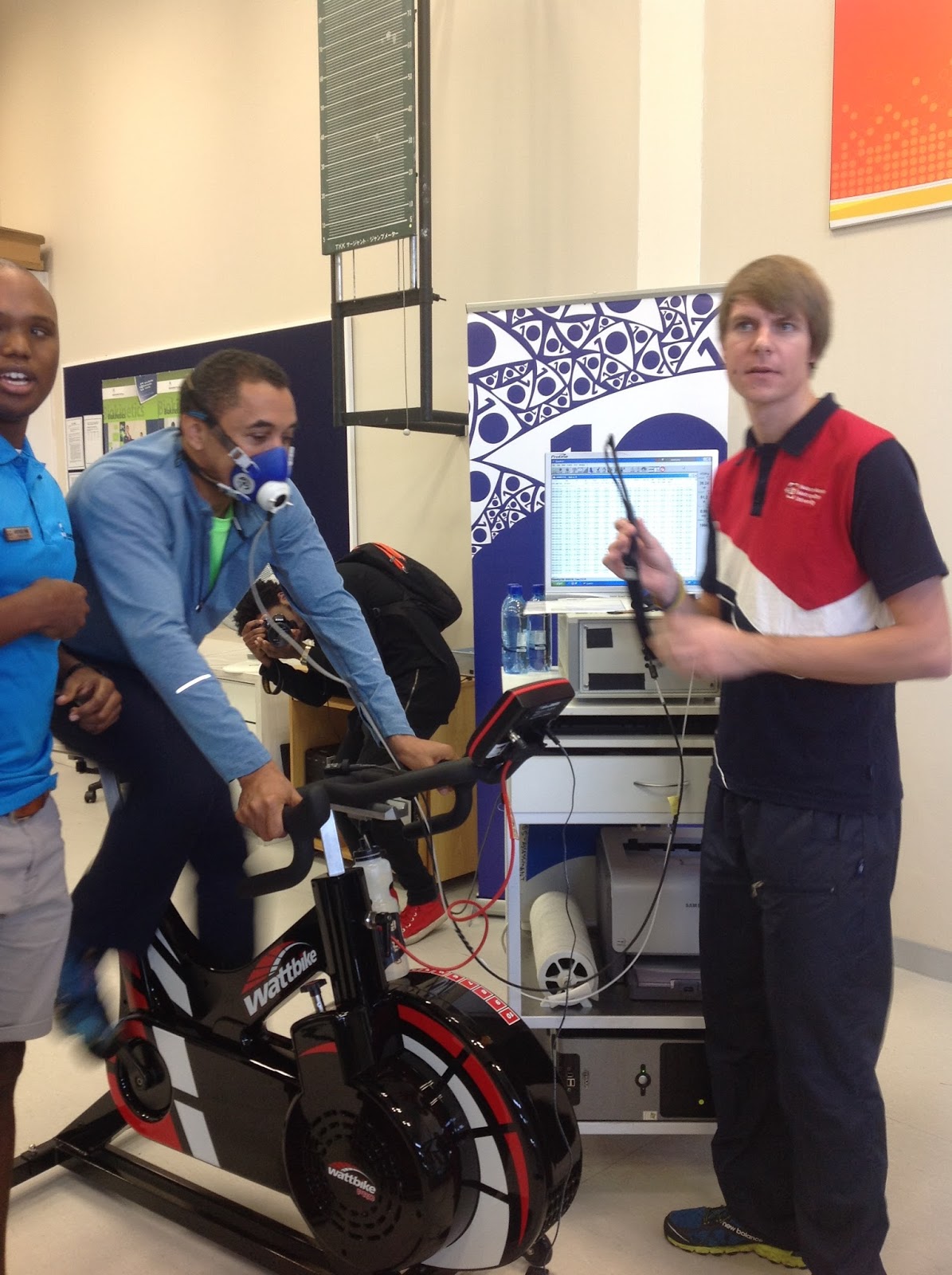
These were the words uttered by our brave chief executive and Vice-Chancellor, Prof Derrick Swartz at the rowing challenge at the Fitness and Aquatics centre yesterday in response to what his mantra will be as he attempts to summit the more than 3700-m high Mount Fuji in Japan next week.

So there I was, waiting for this rowing challenge to begin; learning new words like “ergo machine” from those with an adept knowledge of all things fitness. Then came the Q & A session – while some took this opportunity to personally wish the VC good luck – I couldn’t help but pick his brain and by extension, his soul, when I asked him what his mantra be will.

NMMU Vice-Chancellor Prof Derrick Swartz participates in a rowing challenge as part of his preparaion
You see, we all have our mottos/quotes/sayings which we internalise and repeat to ourselves to keep ourselves motivated. We often remember these during times of strife and hardship, as it is through this adversity that one’s character and mettle is tested. And there is no doubt that his will be tested on the mountain.

In my nervous attempt to string together coherent sentences while asking the VC a question, I remembered the African proverb which I hold dear.

It reads thus:

“If you want to go fast, go alone. If you want to go far, go together.”

I thought this to be quite symbolic owing to the nature of the #climb4nmmu campaign, which has sought to raise funds for academically deserving yet financially needy students using a crowd funding model. This model challenges corporates and individuals alike to donate however much they are willing, with the aim of reaching R500 000; a target which we have since surpassed, as we now stand at R764 000 (at last count), with a new target of R1 million.

The #climb4nmmu campaign has consisted of a number of events that have seen corporates, staff, students and the Nelson Mandela Bay community coming out to show their support for the VC. This proves that although he might be climbing that mountain alone, we are with him in spirit.

Those of you who are acquainted with Prof Swartz’s oratory prowess should be aware of how strongly he believes in the power of the human spirit. This, he says, is going to be his driving force as he climbs up that mountain with the occasional “I will make it” emanating from under his breath.

“The belief that I know I’m going to make it,” is what will keep him going.


Remember not too go fast Prof, but go far; we are right beside you every step of the way.

Below: A selection of photographs from the Rowing Challenge at NMMU's Human Movement Science Centre on South Campus.


Friday, 3 July 2015

What do you do for fun?: "I climb mountains"

Guest blooger Roslyn Baatjies
I imagine that the answer to this question: ‘’So, prof what do you do for fun?’’, to NMMU Vice-Chancellor Prof Derrick Swartz would be, ‘’I climb mountains’’.

I thought about that this morning when the man himself spoke about his planned climb of Mount Fuji in Japan next month to raise funds for bursaries for our financially needy students.  He mentioned that he recently did mountaineering in Norway and that he was invited to climb Kilimanjaro with another group. Unfortunately the latter clashed with his university commitments.

As part of Prof Swartz's personal commitment to the University's 10-year celebrations, he will be climbing Mount Fuji in Japan on 7 August to raise funds for academically-deserving but financially-needy students at NMMU.

The poster for the VC's #climb4nmmu
The #climb4nmmu campaign will also give Prof Swartz the opportunity to highlight the extent of the need for financial support for such students especially within the Eastern Cape, which is recognised as the poorest province.

Prof Swartz's 3,7km climb will be symbolic of the challenges many students face in order to get a tertiary qualification such as perseverance, taking responsibility and integrity. There are 10 base camps leading up to the peak, one for each year of NMMU's first decade.

All funds will go to the University's Bursary Legacy Campaign run by the NMMU Trust. Their Ignite a Candle campaign is already supporting worthy students.

The University is hoping to raise at least R500 000 to support a further students for the duration of their degrees or diplomas.

"I studied at university because of the bursary support I received from people I never knew personally. My bursary was a gift from the past to the present.”

"I strongly believe that this is our generation's responsibility too. We can give back in thousands of different ways. The #climb4nmmu campaign is just one way,’’ says Prof Swartz.

The VC, Prof. Swartz during fitness test.
The VC addressing the media this morning.
Everyday mountains have a way of humbling us. It has a way of connecting us to ourselves, nature and to others, by simply being out there. Embracing adventure means knowing it’s not always going to turn out exactly the way we want it or expect it to and so are the mountains, just like life. 

So in the same way the daily challenges give our needy students a new perspective, we bid that our vice-chancellor will embrace this adventure and not only raise funds, but come back to NMMU with new ideas to challenge us and the status quo.

The University has created a dedicated website in support of the #climb4nmmu campaign. Go to http://trust.nmmu.ac.za/VC-s-Climb-Campaign

Tuesday, 30 June 2015

Opportunities galore for learners and students this recess


Guest blogger Roslyn Baatjies
For many learners school’s out, but for those who intend improving their marks and getting into university next year, there is no rest.

Driving into work this morning, we saw a number of young people entering the campuses and someone asked when lectures are ending. I responded that lectures have ended and that those young people were learners attending either the accounting or engineering winter schools or the Science Discovery Week at NMMU.

This week close to  900 Grade 11 and 12 learners will be exposed to the fascinating worlds of accounting, science and engineering over the June/July school holidays at Nelson Mandela Metropolitan University.

The Science Discovery Week – that will be attended by 300 learners from 56 schools in the Eastern Cape - promises to open the eyes of Grade 11 and 12 learners to the intriguing fields of Science in a fun and informal setting. Daily activities will include visits to various Science Faculty departments where learners will participate in subject-specific experiments.
Offered for the past eight years, the event started off with 60 learners and has now grown to 300 participants. With topics like ‘’Game Changers - The Good, the Bad and the Ugly of Science”, “Light Fantastic” and ‘’Chemistry Unplugged‘’ learners will not only be educated, but also entertained.

NMMU’s Accounting winter school programme, geared towards helping Grade 11 and 12 pupils improve their marks and their chances of attending university, boasts an impressive track record.

Almost a third of the 520 pupils who attended last year’s Grade 12 winter school successfully registered for degrees or diplomas at NMMU. An analysis comparing their June matric results with their December results has revealed that many of them shot up by as much as 30%.

This year’s week-long Accounting winter school for Grade 12s, sponsored by Deloitte, takes place from June 29 to July 3, while the three-day Grade 11 winter school, sponsored by PricewaterhouseCooper (PwC), takes place from July 7 to 9.

The annual engineering winter school has been offered for the past 10 years and will take place from 12 to 17 July. The programme for 30 learners from 14 high schools will include, among others, visits to VWSA and Continental Tyre.

In addition, a winter school project with a difference will be held off-campus by the NMMU Department of Social Development Professions and driven by social work lecturer Dr Veonna Goliath.

Dr Goliath says the winter school is truly interdisciplinary in nature and has a longer term community development focus.

The project, located in the Northern Areas at Bethvale Primary School, was initiated by the Uniting Reformed church in Chatty and part of Dr Goliath’s  post-doctoral work. From Monday 29 June to Thursday 2 July 2015 tutors from mainly the Faculty of Education’s postgraduate programme will tutor Grade 10 and 11 learners in specific subjects.

And in rural Eastern Cape, our SRC is making information accessible in a bid to assist high school learners in raising their awareness of matters relating to access to higher education.


At NMMU there definitely is no lack of opportunities to share or gain knowledge. 

Tuesday, 28 April 2015

‘We are Africans, before we are South Africans!’

Guest blogger Khanyisa Melwa
In recent weeks, South Africa has seen the re-emergence of a phenomenon that has claimed the lives of a number of our fellow African brothers and sisters; one that has divided our nation and continent - this phenomenon is that of xenophobia.

While some might wish to engage in intellectual debate of Afrophobia vs xenophobia, Nelson Mandela Metropolitan University (NMMU) students chose to have their voices heard and marched against the senseless killing of Africans by Africans. The #SayNOToXenophobia march was a joint effort between student leaders, the Centre for the Advancement of Non-Racialism & Democracy (CANRAD) and many others, which took place on 23 April – and saw about 3 000 students, staff and members of the Nelson Mandela Bay community uniting in one voice to say: Not in our name!
NMMU staff and students came out in large numbers, marching from North to South Campus to make their voice heard

NMMU Vice-Chancellor Prof Derrick Swartz

Staff and students at NMMU come together in a march against xenophobia 
The march began at North Campus, just outside the Conference Centre, with scores of people from all walks of life coming together as one, against the scourge of xenophobia. We then proceeded to South Campus where a pledge, signed by over 10 000 members of the NMMU community was handed over to the Vice-Chancellor, Prof Derrick Swartz, together with Chairman of Council Judge Ronnie Pillay, Nelson Mandela Bay Mayor Councillor Ben Fihla and Eastern Cape Premier Phumulo Masualle.

Prior to the handing over of the pledges, we were greeted by the beautiful voices of our world- renowned NMMU choir, followed by speeches from the Mayor, Premier, VC and student leaders.

Students at NMMU make their voices heard with a silent march
What is also worth noting is that although it was a silent march, we weren’t completely silent, as the march afforded us the opportunity to interact and engage with people you otherwise might never have met.

I had the pleasure of having a conversation with Port Elizabeth businessman and former political activist Khusta Jack about the state of our nation and the advent of these xenophobic attacks. Such opportunities are few and far between. Hence I relished the pearls of wisdom he imparted.

He encourages us to read more and engage each other on critical issues, thus raising our sense of consciousness, just as they did during the struggle for liberation.

Residence students were there too
In his infectious and charismatic manner, our Vice-Chancellor delivered a speech that spoke to three very important themes. The first being the apprehension and punishment of those who are inciting these violent attacks and calls for the arrest of anyone who brandishes weapons with the intent of causing harm to another.

Secondly, accountability … “Those who are responsible for these crimes should be held to account” he says.

Thirdly, he encourages the creation of an inclusive economic system; one that will see every citizen existing in a politically, socially, as well as economically just South Africa.

It was very interesting to see the kind of celebrity status our VC enjoyed once the event was over. Almost every student was trying to either get a selfie (selfie sticks and all) or introduce themselves to the man. The excitement and jubilance shown by the students when in the presence of our leader must not be neglected. That one speech, that engagement, will surely bode well for the camaraderie among our students. Hopefully, more engagements will follow.

This violent scourge has sadly divided Africa and her people. It is however refreshing to know that the consciousness of NMMU students has been awakened. This asserts my belief that it is our generation that will change the status quo, and alleviate these unjust social ills that continue to plague our society.

Furthermore, this reinforces our stance as a dynamic African university that seeks to produce quality individuals who will add to the global knowledge economy.

It also reinforces our commitment to uphold the values of Ubuntu and respect for diversity; our students espouse these values with aplomb.

It was only fitting that we stand firmly against xenophobia, bearing in mind that about 8% of the 27000 students that attend NMMU are international students. Some identify with NMMU and South Africa as their home. We identify with them as our brothers and sisters and nothing less.

If we err, let us err on the side of compassion. Because we are Africans, before we are South Africans.

PS And thanks to NMMU staff member Selwyn Milborrow and Nikolaas du Plooy for the photographs.

Wednesday, 8 April 2015

From statues to random acts of kindness


Guest blogger Bev Erickson
Our country is really experiencing a lot of turmoil with what’s happening around the issue of statues and their colonial connections. Everyone has their own opinion on this and I’m certainly not going to go into it here, but it certainly got me thinking about things and about students in particular.

Having worked in the higher education environment for many years – I’ve been exposed to students, lots of students (I guess that’s what keeps me young!). According to our old friend the dictionary “A student is a person who is studying at a university or other place of higher education” and the origin of the word is from Latin - student- 'applying oneself to', from the verb studere, related to studium 'painstaking application'. It’s this painstaking application by our NMMU students that I’m referring to here.

We see it all the time – our students who painstakingly study hard to achieve great results and in the process, not only bring honour to themselves and their families, but to our university family too. Others painstakingly apply themselves to complete their studies and achieve great heights in their chosen sport or other extra-mural activities – and we have lots of them too who fly the fly very high.

Then there are those who are painstakingly apply themselves to helping others. There are so many examples of this taking place at NMMU every day – I think of our Human Resource Management students’ “Pay it Forward” project which they run each year, the Beyond the Classroom students who do so much good for others, the Enactus Society putting service first and now the Random Acts of Kindness group, started by first-year Computing Science students who filmed a video and have started a Facebook page as “a platform for everyone to post and share their random acts of kindness - spreading the love for one another.”

Check out why NMMU students make us proud - https://www.youtube.com/watch?v=ruDlOPx9OzY

So these things got me thinking. Are our students different? Are they special? Do they care more than others?

My answer is YES, I think they are special. We so often see our value of ubuntu being demonstrated and lived by our students and it is so heart-warming and uplifting. Many a time I walk away from a student interaction and think that our future is bright.

So with faeces being flung at statues, riders being flung from horses, our namesake’s likeness in front of the Union Building under threat of being toppled – what I see at NMMU is upliftment, kindness and the building of a great future.

NMMU students – you make me proud!

Thursday, 12 March 2015

#NMMUWalk - Putting the ‘social’ back into ‘social media’

By guest blogger: Khanyisa Melwa

The advent of social media has completely changed the way we interact and engage with one another. Filters and hashtags have become somewhat of a lingua franca. As millennials, we are often referred to as hyper-taskers and our teenagers are now screenagers. We live in the information age, an age where one chooses to be ignorant as information is readily available with a click of a button.

With this in mind, it was quite refreshing to be a part of an event that puts the ‘social’ back into social media. I’m talking about the first #NMMUWalk that was hosted by Cityofpe together with the Nelson Mandela Metropolitan University (NMMU) on Tuesday evening.

The #NMMUWalk is essentially an Instawalk (Instagram Walk) which is about getting the community together to take pictures of our beautiful city/campuses and share them on Instagram. It’s an opportunity for people to get to meet the people behind the Instagram accounts and interact with them on a human level. “It’s about growing the community, that’s our emphasis” says Joshua Terry, one third of Cityofpe. The community in this case, was the NMMU community.

The walk began at Madibaz Café, with some quick treats, because you know – food. Whilst enjoying the delicacies, I couldn’t help but feel like an amateur (which I am) when I heard these guys and girls talk about their lenses and cool cameras. Canon 550D’s, ISO’s and Insta-lenses were the order of the day. Did you guys even know Insta-lenses existed? I didn’t. Apparently some company in Cape Town manufactures these, a pretty nifty gadget for you iPhone users.

Our Instawalkers at the kraal.


We then missioned down to the kraal to begin our expedition, in search for the coolest shots of our beautiful campus. Bar the odd selfie here and there, our Instawalkers achieved this with aplomb, as a plethora of beautiful pictures of the campus can be seen under the hashtag - #NMMUWalk on Instagram.

River Leask doing a 'RiverJump'
What was even more interesting was how 25 completely different students, with everyone studying different courses and from different backgrounds could come together for a new experience and enjoy it so much. We all came to take pictures of a beautiful campus and share these on Instagram but the bi-product of this was that friends and connections were made and for some, followers were gained.

Barriers were transcended at the #NMMUWalk; people you would normally speak to over an app using a smartphone were now standing right next to you taking the very pictures that would leave you awestruck on Instagram. Not only that, but societal barriers were also dismantled, this was evidenced by the diversity of the students present. This goes to show how social media – which is famous for rendering active-users as anti-social can now be used as a socializing agent, which can only bode well for social cohesion in our beautiful country.


It’s really cool to know that we go to a university that encourages creativity, diversity and a vibrant student life. Kudos to the lads from Cityofpe for hosting this event with NMMU, I hope this was the first of many.

Photo: Stuart William Black aka Crazyninja88 on Instagram

Wednesday, 18 February 2015

Meeting the maths challenge

Maths was never my strong point. But I recognised its importance and thankfully was blessed with great teachers, which meant I was able to comfortably pass maths in my final matric year.

Not so for the majority of South African learners, and especially those living in rural backwaters in the Eastern Cape. The province’s dismal maths results speak for themselves.

The national 2014 matric results for mathematics, mathematics literacy and physical science were worse than in 2013, and those results were even worse in our province, which has traditionally always trailed the rest of the country. In fact, we are bottom of the class on a global scale.
Ouch! I cry.
Opportunity! cried Nelson Mandela Metropolitan University (NMMU).
Yes, here’s an opportunity for the university to apply its research and give back to the society it serves.
So enter the Govan Mbeki Maths Development Unit (GMMDU) and a group of committed mathematicians who are determined to become part of the solution. They’ve been rolling out various initiatives aimed at both teachers and learners throughout our province for several years but are now able to seriously able to extend their efforts thanks to a R3.6-m donation from Old Mutual.
Seeking solutations ... Old Mutual's Nceba Papuma and Marshall Rapiya,
 and NMMU's Prof Werner Olivier and Prof Andrew Leitch 
As a result, 18 rural high schools in the Bhisho area will receive a maths and science boost in the form of an extensive offline programme that is aligned to the national curriculum.
The two-year project using tablets and other technological aids is being run in collaboration with the province’s Department of Basic Education.
And that’s another big plus about this Maths and Science Development Project – it’s not about one group working in isolation but about various players coming together to seek solutions. It’s about each one playing its part and working together to ensure that two plus two does not make five, but that it all makes sense.
Personally, this is the kind of research I enjoy best – real research offering real solutions.
About 2 500 learners from grades 10 to 12 will be assisted in this project – a drop in the ocean, but a start nonetheless.
The initiative recognises the education challenges that South Africa faces – under-resourced schools, teachers who lack the relevant maths and science skills and a lack of access to information. It’s a technology-based approach (this, after all, is the screenager generation) that offers lessons, science laboratory videos, old exam papers and self-tests. With each project that the GMMDU rolls out it makes improvements in its bid to better harness the potential of learners and ensure that their maths and science marks improve.
And while the learners are learning, NMMU will be learning too since it has a PhD project on the go examining the use of tablets and their impacts in terms of the expectations of modern learners.
Surely this is a win-win situation?

The proof will come with time - with the matric results.

Monday, 26 January 2015

Dare we get excited about our new SRC?

SRC President Hlomela Bucwa and Deputy President Thanduxolo Bhengu
Year in and year out, we go through the motions of electing a new Student Representative Council (SRC), and year in and year out, we hear exciting manifestos and promises of progress, most of which amount to naught.

This year, dare we hope that the young men and women tasked with representing the students of Nelson Mandela Metropolitan University (NMMU) will live up to their promises?

I’m hopeful.

In fact, I’m excited about the SRC of 2014/15 after attending their investiture today.

Not only do we have our first female president since NMMU began ten years ago, but we also have a team which, at face value, recognises its role as servant leaders.

What a pleasant change from the usual demands of the Me-Myself-I generation.

This team of 21, along with seven faculty representatives, is committing itself to honesty, humility and to seeking solutions if the inaugural speech by its president Hlomela Bucwa is to be believed (see full transcript of speech at end).

I believe it. I believe it because the final-year Law student spoke with sincerity and passion. She spoke of the vision of the SRC, its simple mission of representing all students and its many strategic priorities – not least of which is ensuring that those who are academically deserving of studying further be given that opportunity.

“We practice a humanizing approach within the classroom. But there is nothing humane about a student who is forced to sleep in the bathroom; there is nothing humane about turning away a student with 41 points just because there is no funding; how can we send students out to sleep on the streets?

“We need to have a humanizing approach outside of the classroom too,” an eloquent Hlomela implored her high-profile audience of NMMU executive management.

And that is why the new SRC has committed to prioritise and attend to what is really important – starting with access the education for deserving students.

For Hlomela this also means “the parties, Mr and Miss NMMU, and the like” will have to wait too. “It’s simple. It’s about going back to basics and recognising our priorities”.

With only 381 first-year students successful in attaining NSFAS funding (they heard on Friday last week), Hlomela and her team know that much work lies ahead. After all, NMMU welcomed 5 850 students to its ranks on Saturday. Considering that the bulk of NMMU’s students come from the country’s poorest province, the Eastern Cape, financial assistance for just 380 first-year students is miniscule. Guestimates are that close to 90% of those who study at NMMU need financial assistance of some sort.

So the SRC of 2015 has a big ask ahead. But I’m confident they’ll break ground. After all, the Sakh’ingomoso campaign to assist disadvantaged students is already underway and reaping rewards for students who might have otherwise lost out on a university education.

We wish the SRC well in implementing its plans and promises – initiatives that can only make NMMU a better place for its students.

SRC inaugural speech by Hlomela Bucwa

“But I being poor have only my dreams; I have spread my dreams under your feet; tread softly because you tread on my dreams.”

The SRC is a statutory body created by the Higher Education Act 101 of 1997. Chapter 4 of the Act provides that “The establishment and composition, manner of election, term of office, functions and privileges of the students' representative council of a public higher education institution must be determined by the institutional statute and the institutional rules.”

With profound gratitude and humility I stand to present the vision of the SRC.

Vision
Our vision as an SRC, taking into consideration the vision of the institution, is to a dynamic, transformational SRC recognised for its leadership, policy reform, innovation and vibrant student life. To be an SRC that considers the best interest of students at all times through maintaining integrity, accountability and respect. This will reflect in both the strategic and operational goals of the SRC.

Mission Statement
Our mission is to represent all students to the best of our ability, to re-establish an SRC that is accessible, transparent and accountable to its students. To ensure integrated leadership amongst SRC, its sub-councils, societies and house committees.

SRC Strategic Objectives
Access & Success
Academic Excellence 
Student Housing
Campus Cohesion
Student Development & Sport Transformation
Policy Reform
Communication
Social Cohesion

29 RSA Constitution states
            Education
            (1) Everyone has the right-
                        (a)        to a basic education, including adult basic education; and
                        (b)        to further education, which the state, through reasonable measures, must make progressively available and accessible.

NMMU is situated in the Eastern Cape, one of the poorest provinces in the country. There is unequal access to resources and infrastructure, which has a direct impact on the level of access to education, lack of success in institutions of higher learning and minimal transformation.

It has become culture in our country that every year after the release of the matric results our students fill our admission offices seeking access into the university. One might argue that these students should not be given the opportunity to apply. However, the circumstances that prevail in our province do not allow us to adopt this view. Our students study in poor conditions with a lack of resources and qualified teachers. They lack the inspiration to want to further their education and this is mostly caused by the lack of funding for higher education and training. Our education system must improve; free education is good however quality education is even better thus we must strike a balance between cost and quality.

Initiatives such as Sakhi’ngomso and Operation Sangena by the SRC are to be used as tools in achieving this goal and not merely to fill the calendar. They must be well structured so as to fulfil their set objective, primarily that of access to university. A strategy needs to be formulated on how the SRC and University Management can improve the application process and admission form to have an effective and inter-related relationship between the various university departments, furthermore must invest in community development to ensure that prospective students are groomed as early as Grade 9 through information sharing and mentorship.

It must be noted that we cannot speak about access without entertaining the issue of funding.

“Our lives begin to end the day we become silent about things that matter” - Martin Luther King Jnr

I must express my disappointment in how we have dealt with Financial Aid thus far as an institution and I speak upon the pilot project of NSFAS that we became a part of in 2014. I was in the forefront of our SRC marches with colleagues of the SRC and the DASO march late last year.

I must commend the work Financial Aid has done thus far under the leadership of Mr Wayne Muller who has worked closely with us as an SRC in this crucial time. However, it cannot be Mr VC that every year the incoming SRC raises the same issue.

NMMU has accepted 5000+- first years YET NSFAS has only accepted 381 students with what money are these students to study. What becomes of their dreams, what becomes of their future?! We have heard of the advantages of the new systems but we see the disadvantages on a daily basis.

The disappointment in a parent’s eye who has been waiting for the list with the hope that her son’s student number will appear. When we walk back with them to a residence not knowing where they will sleep or what they will eat.

Sometimes the SRC is forced to break rules and policies and it would seem like we are ill disciplined. For the first time in a leadership journey I saw my Deputy President in distress … it dawned on us that we are dealing with people’s lives the great responsibility we have.

A strategy needs to be formulated on how the SRC can better assist students with their academics. It is then imperative that we continue to advocate for initiatives such as the 24-hour library service, more tutoring and mentoring sessions in residences and the introduction of a weeklong study break. Furthermore, install study and computer labs in all residences, video recorded lectures and moving of supplementary exams to December. However, we cannot be limited to these as the SRC and its sub-structures such as the Faculty Council together with academic societies must work hand in hand with the SRC to achieve this objective to enhance academic excellence.

Integrated Leadership
The SRC 2015 has a vision to create and promote a culture of an integrated student leadership, to work in close-knit with various student governance structures. The SRC is the highest student decision making body entrusted with the responsibility to represent students in upper management. Sub-structures such as societies and the residence council are under the care of the SRC and are to work with the structure to serving students.

In the past it was been evident that these structures have worked in isolation and have merely seen the SRC as a sponsor and not as a partner or guide. It is this disturbing trend that is developing which we seek to do away with. The SRC must be able to consult with these sub-structures; it must be able to task a residence/society.

Policy Reform
Institutional policy is at the core of work as student leaders. Thus policy knowledge and training is essential in ensuring that our strategic objectives are achieved and we are able to champion student issues successfully.

Relationship with the institution
I am delighted to see you here this morning in spite of your busy schedules … you reveal that you are determined to work with us.

The logo
The circular nature of the outer element suggests cyclical and continuous change - a key element of a university, fostering fresh thinking and innovation. It is also suggestive of a rising sun, a new dawn - the birth of a new university. The circle is a symbol of unity, with the triangular elements representing diversity, as well as engagement and interaction, both amongst ourselves and our stakeholders in the broader external community. The inner element emphasises that we are a people-centred organisation, striving to optimise the potential of all our people. It is also suggestive of a learning and supportive environment. The globe represents our international sphere of influence, as well as our connection to our natural resources.

Building an effective SRC
“The ultimate measure of a man is not where he stands in moments of comfort and convenience, but where he stands at times of challenge and controversy.”

My first encounter with the SRC was in my first year at the first year’s picnic. I met the SRC President. I remember coming home and informing my parents that I wanted to be in the SRC and their response was NO.

Four years later I now stand before you as a President and this journey would not be complete without acknowledging my former colleagues who we struggled together, brutalised, went hungry, uniform less with and we formed a brotherhood. And yes, I become one of the boys as I was the only female in the caucus. I must thank Thanduxolo Bhengu, Baxolile Nodada, Duncan Monks, Luthando Mtyobile; Kwezi Mandabane.

What drove us was not because we had nothing better to do but the passion we had to serve others. Bax will always say we don’t have to do what we do. Some of us have funding, accommodation, come from decent homes and lack nothing yet you sacrifice your time, academics, family, friends for the service of others.

In order to achieve our set objectives and vision the SRC as a structure must be effective and functional. SRC members must view themselves in the same equal footing as student leaders elected to serve and represent students.

The SRC has 21 central portfolios and all ought to be functional furthermore must be an action plan and a vision for each portfolio in line with the vision of the SRC as a whole and the institution. SRC members must respect and uphold the Constitution as should the student body as a whole. It guides us as a structure and informs our decision making even though it may be amended.

The executive committee merely exists to ensure the day-to-day running of the SRC and all portfolios report to the executive as provided above. Understanding that all members are equally there still remains the principle of order and stability that must be maintained. As such, the organogram, reporting procedures and communications channels adopted by the SRC must be followed by all members.

We have been entrusted with a huge responsibility and the privilege of serving in the highest student decision making body. Students must always remain central.

It is the mandate of the SRC to ensure that it devises ways to eradicate student challenges and serve the interest of the student body as a whole to ensure that the SRC fulfils its mandate. It is important for the structure to understand its background and provide strategies that will seek to remove the vast margins of inequality. Members of the SRC must also go back to basics by focusing on crucial issues that affect our students and the community at large.

Honesty
Humility
Solution driven

Always remember the mandate … students remain central.


Thursday, 15 January 2015

Helping the ‘rabbits’ … New beginnings at NMMU


You can spot them the proverbial-mile-off with their uncertain body language, trying to fade into the background along with that rabbit-caught-in-the-headlights look of theirs.

Well, that’s to be expected, isn’t it?

It’s certainly how I feel when dropped into new situations – more than a just little anxious in my new unfamiliar surrounds.

And that’s as it’s likely to be for the bulk of the class of 2015 that will be officially joining us from Saturday 24 January when Nelson Mandela Metropolitan University (NMMU) hosts the Welcoming Ceremony for first-years and their parents.

For 12 years, most of the near-6 000 students who will be joining NMMU, have lived at home and attended the same schools. They’ve grown accustomed to certain routines, people and their environment. They were comfortable.

That’s all about to change – so there’s bound to be anxiety.

The changes are bigger for some than others. The child who attended a high school in Summerstrand, Port Elizabeth, and already has siblings at NMMU, for example, is likely to find the shift far less daunting than the matriculant from a rural village in the former Transkei.

But all, regardless of their background, will have some anxieties.

Those anxieties will range from not knowing a soul to finding a place to live; from raising the necessary financial support to not understanding words like “VC”, “DP” and “being an undergraduate”; from the fear of getting lost to that of making new friends; from the worry of not letting your parents down to what to wear to lectures …

We know these worries will fade but they’ll dissipate far sooner with the right support.

NMMU has all sorts of support structures with its How2Buddies, Student Counselling and Campus Health services and the like to ease the process of adapting to a whole new lifestyle, but in my experience, the best support (or lack of support) comes from those we encounter in our daily interactions.

A cheery hello, a smile or an offer of help all go a long way to easing anxieties for newcomers, along with invitations to social events and the presence of other newbies (you are never alone).

So here’s my appeal to those who work and are already studying here … at the very least, please spare a smile for all newcomers.

And to all newcomers, embrace those smiles and other offers of help in making you fill like you belong as a Madibaz because this time next year you’ll be doing the same – you’ll be helping the “rabbits”.

Tuesday, 13 January 2015

Make your dreams come true …


Today is international Make Your Dream Come True Day. (I kid you not). I learnt this in today’s newspaper. I also discovered in the self-same publication that Blade and the boys will be increasing State funding to academically-deserving, financially needy students at South Africa’s universities.

This is good news for the oh-so-many young people whose dreams cannot come true without financial support for tertiary studies.

So Dr Nzimande, our minister of Higher Education, is offering funding to some 205 000 students at university and to another 200 000 students at vocational colleges. R9.5 billion is the sum mentioned for this year.

Last year, according to the Herald, the sum dished up to students was R8.3bn, excluding the R1m bailout fee for the previous shortfalls in payment via the National Student Financial Aid Scheme (NSFAS).

It all looks pretty pleasant on paper but past experience has shown us at Nelson Mandela Metropolitan University (NMMU) that centralising the student aid system (partially, as a means of defeating corruption) is not necessarily the answer. It certainly wasn’t for so many of our students. Far fewer students benefitted from the loan system at NMMU in 2014 than in previous years. But perhaps others benefitted elsewhere instead.

Whatever happened then and whatever happens in 2015, we all know that the R9.5bn is never going to be enough in meeting the needs of so many financially impoverished students.

According to the good Minister there are about 425 095 spaces available at South Africa’s 26 universities, 50 technical and vocational education and training (TVET) colleges (the old Further Education and Training (FET) colleges) and 21 Setas.

We have about 6 000 of those places at NMMU each year. Always they are filled. But always there are students who lose out simply because they do not have the money to pay for their studies.

What happens to the dreams of these students?

Do their dreams fade? Do they become part of the sad 25.5% unemployed official statistic for South Africa? Or do they hold onto those dreams?

Walt Disney once said: “if you can dream it, you can do it”.

There’s a ring of self-belief to his statement; something that looks beyond present physical and material circumstances; a cry that encourages us not to give up.

So if there are any students who might be reading this; students who are struggling to find the financial means to book their spot to a better life, please, please, please don’t give up.

After all, it is international Make Your Dream Come True Day – a day dedicated for doing something towards achieving your dreams. So stop thinking, wallowing and wondering and do something constructive towards that dream – ask for help; seek advice; find a job; research opportunities; visit a bank; fill in a NSFAS application form; study harder …

Be a doer!

You might be further inspired to persevere in your dream after watching NMMU’s television commercial http://ow.ly/Heb7l


Friday, 12 December 2014

Be the change you want to see …

Sister Ethel with a young recipient from the Christmas party 
“I may be only one person. But I am one person who can make a difference.”

This phrase, painted on a wall of the Missionvale Care Centre in the impoverished shack lands of Missionvale in Port Elizabeth, is one I will never forget.

In fact, it‘s one I cling to in difficult circumstances and one my colleagues, family and friends are probably tired of hearing about from me. And that’s ok, because it’s not going to stop me - or others at Nelson Mandela Metropolitan University – from spouting the truth.

We all have the ability to change things – if we are simply committed enough.
A message of encouragement to us all from the Missionvale Care Centre

That change is up to you, and of course, it starts with yourself. Understanding, reflecting, dissecting and getting to know who you really are and what you want to be and what you want to see change (for the better).
Day 3 of the annual Missional Care Centre Christmas party for the children of Missionvale

There are few better examples of being the change you want to see in the world than Port Elizabeth’s own Sister Ethel Normoyle.

Almost 27 years ago Sister Ethel began a journey into the informal shack lands of Missionvale that would begin to change the welfare of an entire community.

She had neither money nor supplies to reach out to the forgotten masses of this deprived community. But she had faith and determination (and nursing know-how).

This week I had the privilege of spending time in the company of the people of Missionvale as they celebrated an early Christmas thanks to the ongoing efforts of Sister Ethel. (For three mornings the Missionvale Care Centre hosted the annual Christmas party for the community’s children.)

And this party, during which 3 000 children each received a gift and some sweets, is but one aspect of what one’s woman’s commitment to change can bring.

Today, Missionvale has its own primary school, clinic, clothing warehouse, child development programme, 291 community gardens, community health practitioners, nutrition unit, church and community hall, crafter’s unit, adult development programme, eye clinic, doctor’s service and a team of volunteers from around the globe.

Not bad for a tiny Irish nun with faith.

As much as Sister Ethel will shy from the limelight, she is the one person who made a difference for Missionvale. She inspired others to the same deep compassion she has for the people of Missionvale.

She practiced the change she wanted to see in the world.

What about you?

What change do you want to see in the world?

At NMMU, we encourage you to take responsibility and do what you know will add value, not just for yourself, but for others. 

The volunteers and staff of the Missionvale Care Centre

Tuesday, 9 December 2014

Making history … NMMU’s first summer graduation


Education graduates sisters Cindy-Lee and Lee-Ann Bosch
We made history today … that’s Nelson Mandela Metropolitan University and some 400-plus students as they were capped at the university’s first summer graduation.

And what a happy occasion is was for 400 Education graduates and 30-odd postgraduate students who received their masters and doctoral degree.

The new summer graduation supplements the university’s traditional graduation ceremonies in April – and following today’s successful event, is very likely to become an annual event on the academic calendar.

No less than 63 staff members filled the stage, while the Indoor Sports Centre itself was almost filled to capacity to witness what South Africa desperately so needs (in large numbers) – qualified teaching graduates who are committed to the country’s future.

The Government might well have boasted an increase in the Grade 12 national senior certificate results in 2013 (over the previous years), but we all well know that the state of education in our country is not healthy.

I mean, 500 000 learners who start out in grade 1, don’t even get to their matric year, and those who do, only need a 30% or 40% pass mark for their various subjects to complete their schooling.

When compared with other countries the shortcomings of our own schooling system are even more obvious.

South Africa’s maths and science ranks second last in the world – not second last in Africa, but the world. According to the Global Information Technology Report of last year, only Yemen’s youngsters are worse than ours.

The facts speak for themselves.

Our schooling system is a mess. We are failing hundreds of youngsters.

That’s why today’s graduation is so special. Yes, it’s a first for us - a piece of NMMU history. But it’s these young men and women who have the opportunity to help create a new history for South Africa.

It’s a history in which our education system will produce learners who can read, write, solve mathematical and other problems and think critically. They won’t just scrape through with 30% or 40%, but get at least 50% for all their subjects. They’ll be our leaders and economic drivers of tomorrow.
BRIGHT FUTURE ... BEd FET graduates Jason Field, Anike Botha (a Vice-Chancellor's Scholar), Margaretha and Carla Steyn all completed their degrees cum laude  

We need dedicated teachers to achieve this – people who are committed to the cause of opening young minds to the wonders of knowledge; people who believe in the abilities of people; people who are not driven by lucrative financial jobs but by ideals …

To see 400-plus young men and women of all races graduate with Bachelor of Education degrees (in Foundation, Intermediate and Further Education and Training phase) and with a Postgraduate Certificate in Education or Honours, was gratifying because it signals hope for our future.

It indicates that there are those who recognise the importance of education and are prepared to put their hands up to help turn our present-day “F” into a “B+” or “A” in building a better tomorrow for all our children.


Congratulations to all our graduates!

Friday, 5 December 2014

Living his Legacy


By Bev Erickson
As we celebrate the life of  Tata Madiba, our namesake,  on the first anniversary of his passing – it got me reflecting on the legacy he left behind, and the great leader he was.


I recently had the privilege of listening to the former private secretary of Madiba, Zelda la Grange. Her 60 minute presentation had everyone hanging on her lips as she told humorous and touching stories of her time with Nelson Mandela. She was just so “real” in her approach – nothing pretentious or fake about her – I guess like the man she called boss for more than half of her life.

The story I found particularly fascinating was his attention to detail and what a stickler he was for honesty and integrity. She spoke of a foreign visit when he was given the most beautiful hotel suite – complete with designer bottles of shampoo, body wash and fragrances in the bathroom. Late that evening, Zelda was summoned to his room and asked to fire the entire security team. Madiba had noticed that one of these little bottles had gone missing and would not rest until he had found the perpetrator. As the peacemaker, Zelda lined the entire team up in his room and the perpetrator was identified.  He took note of the little things and he had zero tolerance for dishonesty.

The interesting part of the presentation was the question time afterwards. And of course there were many! She handled them diplomatically and knew where the line was that she wouldn't overstep illustrating her own integrity. 

What a wonderful relationship these two totally different people had. A true testimony to both of them.


Then, last Sunday – I watched Long Walk to Freedom on TV with my husband and 17 year old daughter. I was reluctant to watch the movie as how could anyone even begin to portray such a colossus of a person? But Idris Elba did a pretty good job! It was wonderful to watch the life of Nelson Mandela played out in chronological order – giving a perspective of what he did and achieved in his life time.

Something else that opened my eyes were the comments by my 17 year old on the atrocities of our past and how foreign they were to her. “Did that really happen?”, “Didn't you know it was wrong?” 

But despite the wrong-doings, our beloved Madiba showed compassion and love for his country.

Tata – we will never forget you.


Living his Legacy 1918 - 2013